
Kicking off with Benefits of Electronic Health Records, this opening paragraph is designed to captivate and engage the readers, setting the tone casual formal language style that unfolds with each word.
Electronic Health Records (EHR) have revolutionized the healthcare industry by enhancing patient access, reducing costs, and improving efficiency. This article delves into the myriad benefits that EHR brings to the table, from streamlining health insurance processes to improving patient outcomes. Let’s explore the transformative power of EHR in the realm of healthcare.
Benefits of Electronic Health Records
Electronic Health Records (EHRs) have revolutionized the healthcare industry, offering numerous advantages for patients, healthcare providers, and insurance companies alike.
Improved Healthcare Access for Patients
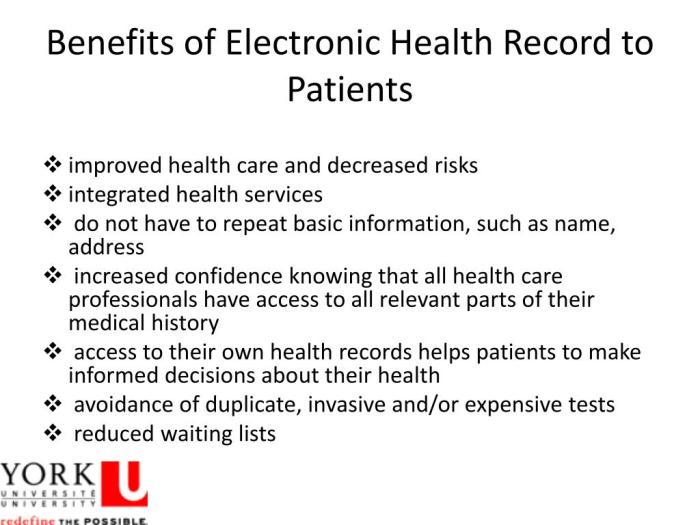
- Electronic Health Records enable patients to access their medical records online, allowing for better coordination of care among healthcare providers.
- Patients can easily schedule appointments, request prescription refills, and receive test results promptly through EHR portals, leading to quicker and more convenient healthcare services.
- Telemedicine services are facilitated through EHRs, providing patients with remote access to healthcare professionals, especially beneficial for those in rural or underserved areas.
Impact on Reducing Healthcare Costs
- EHRs help eliminate duplicate tests and procedures by providing a comprehensive view of a patient’s medical history, reducing unnecessary expenses for both patients and healthcare providers.
- Efficient data management through EHRs reduces administrative costs associated with paper-based records, ultimately leading to cost savings for healthcare facilities.
- Preventive care reminders and alerts within EHR systems help prevent costly complications by promoting timely interventions and proactive healthcare management.
Benefits for Healthcare Providers
- Electronic Health Records streamline clinical workflows by automating tasks such as documentation, coding, and billing, allowing providers to focus more on patient care.
- Improved communication among healthcare team members through EHRs enhances care coordination and reduces medical errors, ultimately improving patient outcomes.
- EHRs enable evidence-based decision-making by providing access to real-time patient data and analytics, leading to more informed treatment plans and personalized care.
Role in Streamlining Health Insurance Processes
- Electronic Health Records facilitate faster claims processing and reimbursement for healthcare providers by ensuring accurate and timely submission of billing information.
- Automated eligibility verification and prior authorization processes within EHR systems help reduce delays in treatment and improve overall patient satisfaction.
- Integration of EHRs with health insurance systems promotes transparency and efficiency in managing patient coverage, ensuring seamless interactions between providers and payers.
Advantages of Electronic Health Records for Healthcare Access
Electronic Health Records (EHRs) play a crucial role in improving healthcare access by providing numerous benefits that enhance patient care and streamline healthcare processes.
Remote Access to Patient Information
- Healthcare providers can access patient records remotely, allowing for quick decision-making and continuity of care, especially in emergency situations.
- Patients can also securely access their own health information, empowering them to take control of their health and be more involved in their care.
Coordination of Care Among Different Providers
- EHRs enable seamless communication and data sharing among various healthcare providers, ensuring that everyone involved in a patient’s care is on the same page.
- This coordination reduces the chances of medical errors, duplicative tests, and unnecessary procedures, leading to more efficient and effective healthcare delivery.
Improved Patient Engagement
- Patients can actively participate in managing their health by accessing their lab results, medication lists, and treatment plans through EHR portals.
- Features like appointment scheduling, prescription refills, and secure messaging with healthcare providers enhance patient engagement and adherence to treatment plans.
Reducing Healthcare Disparities Among Populations
- EHRs help identify at-risk populations and track health outcomes, enabling healthcare providers to tailor interventions and resources to address disparities in healthcare access and outcomes.
- By collecting and analyzing data on patient demographics and health outcomes, EHRs support efforts to reduce disparities and improve health equity for all individuals.
Impact of Electronic Health Records on Healthcare Costs
Electronic Health Records (EHR) have significantly impacted healthcare costs by streamlining processes, reducing unnecessary tests and procedures, improving operational efficiency, and promoting preventive care.
Reduction of Unnecessary Tests and Procedures
- Electronic Health Records enable healthcare providers to access comprehensive patient information in one centralized system, reducing the need for duplicate tests and procedures.
- By eliminating redundant tests, EHR help lower costs associated with unnecessary medical interventions, ultimately saving both patients and healthcare systems money.
Financial Benefits in Operational Efficiency
- Efficient documentation and data retrieval through EHR systems result in time savings for healthcare professionals, allowing them to focus more on patient care.
- Reduced paperwork and administrative tasks lead to cost savings in terms of labor and resources, contributing to overall operational efficiency.
Contribution to Preventive Care
- Electronic Health Records facilitate the tracking of patient health data over time, enabling healthcare providers to identify and address health issues before they escalate.
- By promoting preventive care measures such as regular screenings and vaccinations, EHR help prevent costly chronic conditions and reduce long-term healthcare expenses.
Examples of Cost Savings
- Healthcare institutions that have implemented Electronic Health Records have reported significant reductions in administrative costs related to paper-based record-keeping systems.
- A study conducted by the Journal of the American Medical Informatics Association found that hospitals using EHR systems saved an average of $142 to $156 per patient visit.
Benefits of Electronic Health Records for Healthcare Providers
Electronic Health Records (EHRs) play a crucial role in enhancing communication among healthcare teams. The seamless sharing of patient data and medical records among different healthcare professionals leads to better coordination and improved patient care.
Improved Patient Outcomes and Treatment Effectiveness
EHRs contribute significantly to improving patient outcomes and treatment effectiveness by providing healthcare providers with quick access to comprehensive patient information. This access enables healthcare teams to make well-informed decisions, create personalized treatment plans, and monitor patient progress more efficiently.
- By having access to a patient’s complete medical history, including past treatments and test results, healthcare providers can make better-informed decisions regarding the most effective course of treatment.
- EHRs allow for real-time documentation and updates on patient conditions, ensuring that all healthcare team members are aware of the latest developments and can adjust treatment plans accordingly.
- Through the use of decision support tools integrated into EHR systems, healthcare providers can receive alerts and reminders for preventive care measures, drug interactions, and evidence-based treatment guidelines, ultimately leading to improved patient outcomes.
Support for Evidence-Based Practices in Healthcare
Electronic Health Records support evidence-based practices in healthcare by providing healthcare providers with access to a wealth of data and research findings. This access allows providers to make decisions based on the latest evidence and guidelines, leading to more effective and efficient care delivery.
- Healthcare providers can use EHRs to access evidence-based guidelines, best practices, and clinical decision support tools to ensure that their treatment plans align with current standards of care.
- EHRs enable healthcare providers to track and analyze patient outcomes over time, allowing them to identify trends, patterns, and areas for improvement in their practice.
- By incorporating evidence-based practices into their workflow, healthcare providers can offer more consistent and high-quality care to their patients, ultimately leading to better health outcomes.
Assistance in Decision-Making Processes
Electronic Health Records assist healthcare providers in decision-making processes by providing them with accurate and up-to-date information at their fingertips. This accessibility allows providers to make timely and informed decisions that are crucial for delivering optimal patient care.
- Through data analytics and reporting features, EHRs enable healthcare providers to identify gaps in care, track patient progress, and evaluate the effectiveness of different treatment approaches.
- EHRs facilitate communication and collaboration among healthcare team members, allowing for multidisciplinary input and shared decision-making processes for complex cases.
- By streamlining workflows and automating routine tasks, EHRs help healthcare providers focus more on patient care and less on administrative burdens, ultimately improving the efficiency and effectiveness of their decision-making processes.
Role of Electronic Health Records in Health Insurance
Electronic Health Records play a crucial role in the operations of health insurance companies, streamlining various processes and improving efficiency.
Streamlining Claims Processing
- Electronic Health Records provide health insurance companies with immediate access to patient medical histories, test results, and treatment plans, which helps expedite claims processing.
- By having all relevant medical information stored electronically, insurers can quickly verify the necessity of procedures or services, leading to faster claim approvals.
Verifying Patient Eligibility and Coverage
- Electronic Health Records enable insurers to verify patient eligibility and coverage in real-time, reducing the chances of errors and ensuring that the right services are covered under the policy.
- With instant access to up-to-date patient information, insurance companies can make informed decisions regarding coverage and benefits.
Accurate Billing and Coding Practices
- Electronic Health Records help healthcare providers accurately document patient encounters, procedures, and diagnoses, which leads to more precise billing and coding practices.
- By automating the billing process and reducing manual errors, insurers can ensure that claims are processed correctly and efficiently.
Preventing Insurance Fraud and Errors
- Electronic Health Records play a significant role in preventing insurance fraud by providing a detailed trail of patient interactions and treatments, making it easier to detect inconsistencies or irregularities.
- By improving data accuracy and integrity, insurers can reduce the risk of errors and ensure that claims are processed transparently and ethically.
Influence of Electronic Health Records on Health Policies
Electronic Health Records (EHR) play a crucial role in informing public health initiatives and policy-making by providing a wealth of data and insights for policymakers to utilize. The adoption of EHR systems has fundamentally changed the landscape of healthcare regulations and standards, influencing decision-making at various levels.
Data-Driven Decision-Making in Healthcare Policy
- Electronic Health Records contribute to data-driven decision-making in healthcare policy by providing real-time information on patient outcomes, treatment effectiveness, and population health trends.
- Policy-makers can analyze EHR data to identify areas for improvement in healthcare delivery, allocate resources efficiently, and implement evidence-based interventions to address public health challenges.
- By leveraging the data stored in EHR systems, policymakers can make informed decisions that result in better health outcomes for populations and improved healthcare access for individuals.
Legislative Changes Influenced by EHR Adoption
- The widespread adoption of Electronic Health Records has led to significant legislative changes aimed at promoting interoperability, data security, and patient privacy in healthcare settings.
- For example, the Health Information Technology for Economic and Clinical Health (HITECH) Act in the United States incentivized healthcare providers to adopt EHR systems and implement measures to protect patient data.
- In addition, regulations such as the General Data Protection Regulation (GDPR) in the European Union have been influenced by the need to safeguard electronic health information and ensure patient confidentiality.
Importance of Electronic Health Records in Health Screening
Electronic Health Records (EHR) play a crucial role in enhancing the efficiency and effectiveness of health screening processes. By digitizing patient information and medical history, EHR systems enable healthcare providers to track and monitor health screenings more accurately and comprehensively.
Improved Tracking and Monitoring of Health Screenings
- Electronic Health Records allow healthcare professionals to easily access and review patient records, including past screening results, making it easier to track the frequency and timing of necessary screenings.
- EHR systems can generate automated alerts and reminders for upcoming screenings based on individual patient profiles, ensuring timely and appropriate follow-ups.
Identification of At-Risk Populations for Specific Health Screenings
- By analyzing data stored in Electronic Health Records, healthcare providers can identify at-risk populations that may benefit from specific health screenings based on age, family history, lifestyle factors, or existing medical conditions.
- EHR systems enable targeted interventions and preventive measures for high-risk individuals, improving the overall effectiveness of health screening programs.
Facilitation of Timely Follow-ups and Reminders for Health Screenings
- Electronic Health Records streamline the process of scheduling follow-up screenings and sending reminders to patients, reducing the likelihood of missed appointments and ensuring continuous monitoring of health status.
- Automated notifications through EHR systems help healthcare providers maintain regular communication with patients, promoting adherence to recommended screening protocols.
Examples of Improved Health Outcomes through Electronic Health Records in Health Screening Programs
- A study conducted by [Research Institute] found that the implementation of EHR systems resulted in a 20% increase in the completion rate of colorectal cancer screenings among eligible patients.
- In another case, a healthcare facility reported a significant reduction in the incidence of undiagnosed hypertension through proactive screening initiatives supported by Electronic Health Records.
In conclusion, Electronic Health Records have emerged as a game-changer in the healthcare landscape, offering a multitude of advantages for patients, providers, and the industry as a whole. By harnessing the power of EHR, the healthcare sector can pave the way for a more streamlined, cost-effective, and patient-centric future.
Top FAQs
How do Electronic Health Records benefit patients?
Electronic Health Records improve patient access to healthcare services, enable better coordination of care, and empower individuals to take control of their health management.
What financial advantages do Electronic Health Records offer?
EHR help in reducing unnecessary tests, enhancing operational efficiency, and promoting preventive care measures, ultimately leading to cost savings in the long run.
How do Electronic Health Records aid healthcare providers?
EHR enhance communication among healthcare teams, improve patient outcomes, support evidence-based practices, and assist in decision-making processes for providers.
What role do Electronic Health Records play in health insurance processes?
EHR streamline claims processing, verify patient eligibility, ensure accurate billing practices, and help in preventing insurance fraud and errors.
How do Electronic Health Records influence health policies?
EHR inform public health initiatives, shape healthcare regulations, contribute to data-driven decision-making, and influence legislative changes in the healthcare sector.


